
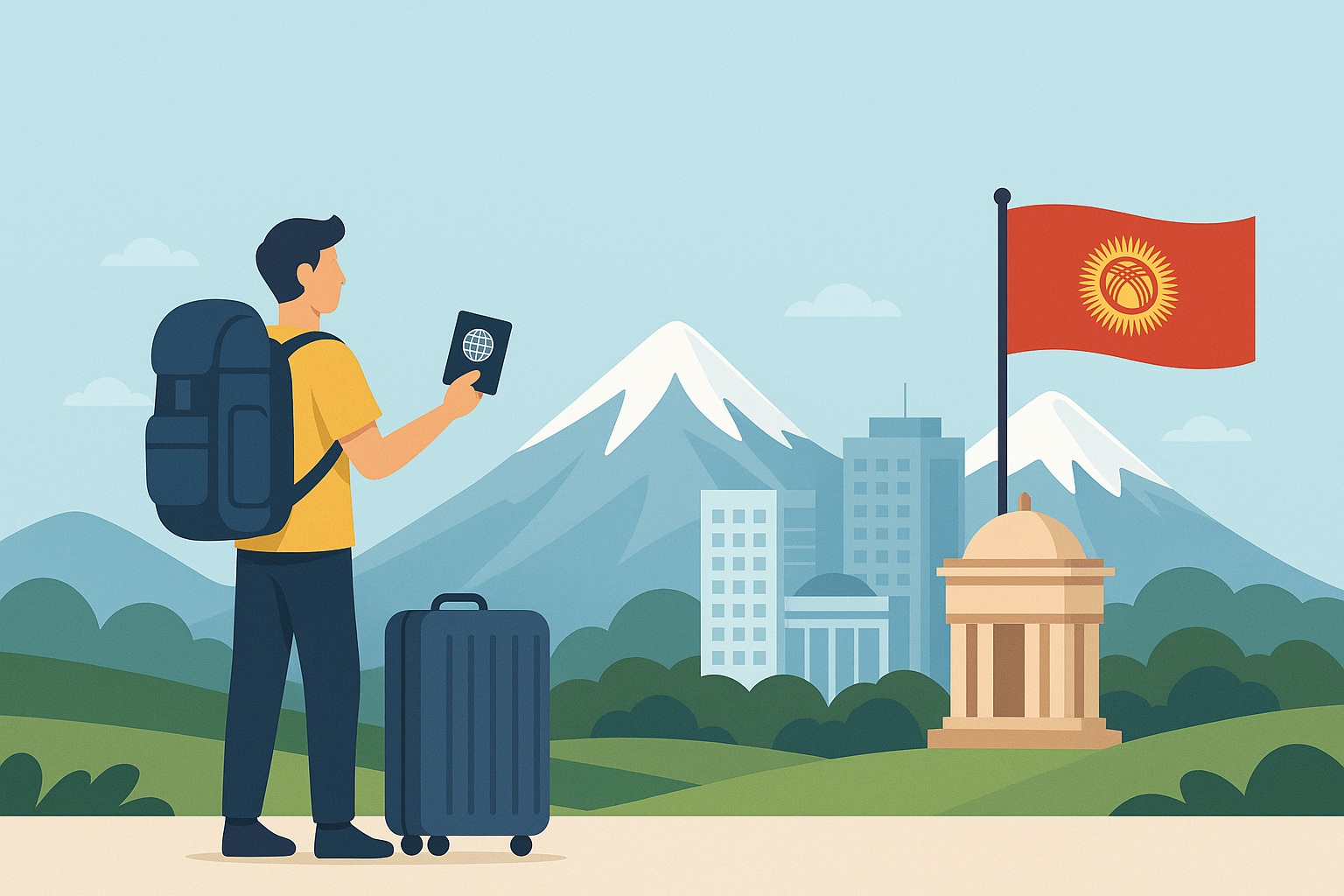
Imagine a city where you can get from the center to a mountain trail in 20 minutes, where a cup of coffee costs less than $2, where rent is about half the price of Tbilisi and several times lower than in many larger relocation hubs, and where opening a business can take just a few days. In 2026, Bishkek has stopped being a “backup airfield.” It has become an independent center of attraction for people looking for simplicity, affordability, and the ability to move and get back on their feet quickly after relocation.
There are several reasons for this.
First, migration policy has traditionally been relatively liberal by regional standards, although in 2026 the entry rules became stricter than many foreigners were used to, especially for visa-free stays. Second, taxes remain low by comparison with many OECD economies, while bureaucracy is still noticeably lighter than in a number of neighboring jurisdictions. According to OECD data, Kyrgyzstan’s tax-to-GDP ratio was 21.9% in 2023, which was well below the OECD average of 33.9%, even though it was above the Asia-Pacific average.
Third, the growth of the IT sector and continuing demand for specialists make Bishkek a convenient base for freelancers, entrepreneurs, and people applying for digital nomad status. The official High Technology Park of Kyrgyzstan continues to position the country as an export-oriented jurisdiction for tech companies, with tax incentives and institutional support for IT businesses.
This combination — affordable living, relatively accessible entry, inexpensive housing, and manageable bureaucracy — makes Bishkek feel like a “new small Dubai” in Central Asia, just without the pretension and with much more everyday warmth.
Why Foreigners Move to Kyrgyzstan: 12 Key Reasons
1. Visa-free entry and a fast start to life
For citizens of many countries, entry into Kyrgyzstan remains visa-free. But in 2026, the rules changed: for citizens of 55 eligible countries, visa-free stay was reduced to 30 days within each 60-day period, and the old “visa run” model effectively stopped working. For some other countries, including several post-Soviet states and a few partners such as Türkiye and Serbia, the 90/180 model continues to apply.
Even with these changes, many relocators still describe the initial landing in Kyrgyzstan in the same simple way: “You arrive, and you start living.” There is still far less entry friction than in many other jurisdictions.
2. Low cost of living with decent quality of life
You can live comfortably in Bishkek even on a modest European or Russian income. The cost of housing, transport, food, and many everyday services remains one of the lowest in the region. In practical terms, Bishkek still ranks among the more affordable capitals in Eurasia, and public statistics continue to publish current consumer price data and tariffs for the country.
3. Good internet and accessible IT services
The city is covered with fiber-optic providers. Home speeds of 100–200 Mbps are a normal standard. For freelancers and entrepreneurs, this is a major advantage.
4. Mountains 20 minutes away
Unlike Yerevan, Almaty, or Tbilisi, mountain gorges begin almost at the city limits. Ala-Archa is roughly 35 minutes away, and you are already on the trail.
5. Simplified access to resident status
Many foreigners obtain residence status in the country through income, employment, business, marriage, children’s education, and sometimes even property-related strategies. It remains one of the more flexible systems in the region, especially when relocation is combined with business structuring.
6. Very fast domestic banking operations
Transfers inside the country are usually fast. Many foreigners keep part of their money in Kyrgyz banks as an “emergency reserve.”
7. Taxes are much lower than in many CIS and EU models
Entrepreneurs opening an LLC or sole proprietorship can often use the unified tax system, which in many practical cases works out to 2–4% of turnover depending on the business model and payment format. For many small businesses, this remains one of the most attractive operating regimes in Eurasia.
8. A simple and understandable rental market
There is usually no need to pay huge deposits. Renting can often be arranged quickly, without endless certificates and guarantors. In practice, a lot of relocators first solve housing through a short-term rental and then move on to a longer arrangement with rent housing options once they understand neighborhoods better.
9. Russian is an official language
This massively simplifies adaptation. For a large part of the relocation audience from the post-Soviet space, it removes one of the main stress factors during the first months.
10. Affordable medicine and dentistry
Good private clinics often cost several times less than in Europe. The same applies to dentistry, diagnostics, and a large portion of outpatient care.
11. A growing IT ecosystem
Meetups, startups, accelerators, and international business trips all continued to grow through 2023–2025, and the infrastructure around the tech sector remains active in 2026. The country’s IT positioning is also supported by the High Technology Park’s official framework.
12. A friendly social environment
Kyrgyzstan remains one of the warmest countries in the region toward foreigners. People often help, explain things, and point newcomers in the right direction.
Cost of Living in Bishkek in 2026: The Honest Reality
This is an important section, because many people choose relocation because of the low cost of living, but it is important to see the full picture.
Housing
1-room apartment, city center: 350–500 USD
1-room apartment in a residential district: 230–320 USD
2-room apartment in the center: 500–700 USD
Modern residential complexes with security: 550–900 USD
Utilities
Electricity: very cheap (up to 20 USD per month)
Heating: 10–18 USD
Water: 3–6 USD
Internet: 8–15 USD
Transport
Minibus: 15 som (≈ 0.17 USD)
Taxi around the city: 1.5–3 USD
Taxi to the airport: 7–11 USD
Food
Café in the center: 3–7 USD
Restaurant: 10–18 USD
Groceries: 250–350 USD per person is usually enough with room to spare
Education
Private kindergartens: 150–300 USD
Schools: 200–500 USD
International schools: 700–1500 USD
What is actually expensive
Branded clothing
Apple devices
Imported medicines
Overall, one person can live comfortably on 700–900 USD per month.
A family of three usually needs 1300–1800 USD.
Entry Rules for Foreigners in Kyrgyzstan in 2026
The general entry rules for foreign citizens in 2026 are no longer as loose as they used to be. The practice of repeated “visa runs” has effectively been rolled back, and cumulative stay periods are now the key principle.
1. Visa regime and periods of stay
For many foreign citizens, a visa-free regime still applies, but the number of days in the country is now counted cumulatively.
The “30/60” principle: Citizens of 55 countries, including many European and Western states, may stay in Kyrgyzstan without a visa for up to 30 days within each 60-day period. Re-entering immediately to reset the clock no longer works the way it did before.
The “90/180” principle: This still applies to citizens of EAEU countries such as Armenia, Belarus, and Kazakhstan, as well as Serbia, Türkiye, Ukraine, and Mongolia. They may stay up to 90 days within a 180-day period.
Exceptions:
Citizens of Uzbekistan may stay without permit documents for up to 60 days within each 120-day period.
Holders of UN laissez-passer documents may enter without a visa for up to 60 days.
For citizens of certain Gulf states, the permitted period may reach 180 days within a 360-day period.
2. Registration of foreign citizens
If a foreigner plans to remain in the country longer than the non-registration threshold, registration becomes mandatory.
Registration deadline: For many foreigners, registration is required once the period of stay exceeds 30 days.
Procedure: Registration can be handled through population registration authorities and, depending on the situation, through online services or through the receiving side. In hotels, the administration often handles this part.
Important: Registration should be completed no later than the last day of the permitted visa-free stay period. Because of this, many relocators arrange temporary registration and housing together instead of treating them as two separate tasks.
3. Documents for entry
Passport: A valid foreign passport is required. In practice, a validity period of at least 6 months on the date of entry is the safest benchmark and is reflected in foreign travel advisories and standard visa practice.
For children: Children increasingly need their own travel documents. In 2026, the practical trend is toward stricter documentary requirements for minors crossing borders.
Electronic visa (e-Visa): Citizens of countries not included in the visa-free list may apply online through the official Kyrgyzstan e-Visa portal.
4. Additional requirements
Transit: Transit is allowed, but the rules depend on nationality and whether the traveler has visas for third countries.
Simplified procedure: In some categories, including certain short-stay cases, short-term visas can be issued under a simplified procedure via Manas International Airport.
Obtaining a PIN in Kyrgyzstan: Why You Need It and How It Is Issued
A PIN is the personal identification number assigned to a foreigner.
It is needed:
- for banks,
- for medical services,
- for long-term residence,
- for property registration,
- for tax purposes.
Foreigners usually obtain it at passport offices, public service centers, or during migration-related applications. Many relocators arrange a PIN in Kyrgyzstan immediately after arrival to speed up banking and legal procedures.
As a rule, a PIN is issued quickly — often within 1–3 working days, and in some practical cases even faster depending on the office and document package. In April 2026, Kyrgyzstan also clarified that a PIN is assigned once and remains valid for life for citizens, foreign nationals, and stateless persons.
To obtain it, you usually need a passport and a residential address. In some practical scenarios, local registration is also requested depending on how the application is filed.
What You Should Do in the First Week After Relocation
Step 1. Get a local SIM card
This can be done through operators such as O!, MegaCom, or Beeline. A passport is required.
Step 2. Get your PIN
You will need it almost everywhere — from banks to government services. The procedure is usually straightforward and often takes little time at a public service center.
Step 3. Find an apartment and arrange registration
It is important to understand that the landlord must consent to registration. Otherwise, you may have to look for another housing option.
Step 4. Open a bank account
This is usually not the hardest part — in many banks, non-residents can open an account, but compliance nuances matter. If you need fast service, it is better to choose a bank according to your income profile.
Step 5. Choose a tax model
It is important for foreigners to understand their obligations in advance. Many seek tax advice before opening a sole proprietorship, an LLC, or structuring remote income.
How a Foreigner Can Live Comfortably in Bishkek: Consultant’s Tips
Over the last two years, I have seen dozens of relocators who felt out of place during the first months and then fell in love with the country.
Here are a few insights.
1. Bishkek is a city of short distances
Living in the center or near Chuy Avenue means getting almost anywhere in 10–15 minutes.
2. Society is friendly, but direct
Kyrgyz people are open, but they value honesty and calm communication. An aggressive tone, familiar to some migrants from Russia, is usually perceived badly.
3. It is comfortable here for children
There are many private schools, kindergartens, and sports clubs. Prices are often 2–5 times lower than in Moscow or Tbilisi.
4. Coffee shops and coworking spaces are the main social environment
Foreigners often start building their community exactly there.
5. Nature genuinely affects mental well-being
The mountains nearby are a form of therapy. Many people start hiking or taking regular trips to Karkara, Ala-Archa, or Chunkurchak.





Leave a Reply